
Love is an intense, ineffable feeling of deep affection.
In its broadest definition, it is the name we give to a transient, indefinite emotional existence. Its reliance or specificity is entirely dependent on contextual relevance, yet its logical foundation is established within the framework of circumstance. It is anchored in an invisible trust—applicable to both the animate and inanimate, yet manifesting uniquely within the sentient. However, there is no fixed nature or dimension to it; its measure is determined by highly peculiar variables, making it perpetually unpredictable. Its variations are vast based on type, operating practically through specific regions of the brain via the secretion of particular compounds. Ultimately, the philosophy governing everything is dictated by the profound influence of the stimulated mind.
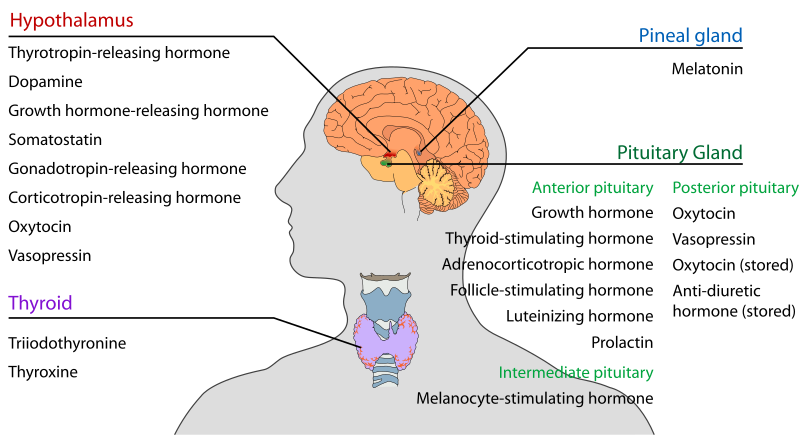
The Endocrine System and Neurological Hormone Cascades
The American Psychological Association (APA) offers a psychodynamic definition of love, describing it as a "complex" emotion that involves: affection toward another individual, a sense of tenderness, and sensitivity to their response.
On an interpersonal level, it becomes profoundly intricate. Here, tenderness, compassion, and sensitivity bear the utmost significance—directing one toward an intense feeling of deep affection. Naturally, it is a vast, overwhelming immersion that is never entirely clear or rationalized.
♥ Love Chemicals ♥
The initial euphoric feelings of being in love are stimulated by three key chemicals in the brain: noradrenaline, which stimulates adrenaline production causing a racing heart and sweaty palms; dopamine, the feel-good chemical; and phenylethylamine, which is released when we are near our crush, giving us butterflies in our stomachs.
According to a team of scientists led by Dr. Helen Fisher at Rutgers, romantic love can be broken down into three distinct categories: lust, attraction, and attachment. Each category is characterized by its own specific set of hormones.
Lust
Testosterone & Estrogen
Attraction
Dopamine, Norepinephrine & Serotonin
Attachment
Oxytocin & Vasopressin
Heart Beats
Feel the rhythm of your pulse
♥ Love Styles ♥
Primary
Eros = passionate love
Ludus = game-playing love
Storge = friendship love
Secondary
Pragma = logical, "shopping list" love
Mania = possessive, dependent love
Agape = all-giving, selfless love
♥ The Philosophy of Love ♥
Romantic Infatuation vs. True Affection
As a human being, it is imperative to distinguish what truly defines the distinct nature of "falling in love" versus "loving someone". The theoretical meaning of love is so vast and profound that to encapsulate it within a single definition is to deny its multi-dimensional significance. It is likely precisely because of this staggering complexity that the greatest philosophers have rendered love an intricate labyrinth.
- In its practical essence: Romantic infatuation is the intense desire to possess and unite with the beloved for the fulfillment of one’s own soul. Conversely, true affection is the selfless expectation of the beloved's well-being; a conscious surrender of oneself to be a mere well-wisher, ready to sacrifice everything for the other's ultimate happiness, with absolute selflessness as its prerequisite.
Infatuation is self-centric; true affection is other-centric. Infatuation is merely a derivative form of affection, but true affection exists autonomously. The boundaries of infatuation are narrow and conditional, whereas the scope of true affection is boundless and universal. Infatuation requires the mutual consent of two parties; true affection is unrequited by nature—the consent of the other is not a prerequisite.
Affection flows from one heart; infatuation requires the collision of two. Infatuation does not necessitate affection for its ignition, yet affection is utterly incomplete without the fire of infatuation. Affection is highly relative. It is a force that fosters deep care, empathy, and a special gravitational pull toward another—a pull you cannot simply choose to ignore at will.
In pure affection, the role of the "two parties" is virtually non-existent; the prevailing role is sacrifice. Affection is a deeply human emotion—an experience rooted in raw feeling. It is the powerful outward expression of tenderness for a specific individual. Yet, affection can be viewed through countless lenses. It is the very essence that separates humanity from bestiality. The power of affection is not constrained to conquering the earth; it is the force that could theoretically conquer the heavens, the throne, and the cosmos. The necessity of love in human life is spiritual in nature. It is universal—it can exist with anyone.
Within this state of true affection, the craving for physical fulfillment never attains ultimate completion. The very desire for union is, in itself, a manifestation of self-centered longing—and self-centered longing can never truly bring about good for another; it only serves its own happiness. Infatuation is the ultimate comfort of the soul and the peace of the mind. It is an electrifying and deeply mysterious feeling, yet one that strictly necessitates duality—it cannot arise from a single side.
In its ultimate reality, true affection is a devotee of sacrifice, whereas infatuation is a worshipper of enjoyment. Generally, self-interest, self-gratification, self-purification, and self-satisfaction are the catalysts for the birth and expansion of infatuation. Infatuation cannot exist without a deep attachment to the beloved. This attachment typically arises from mutual consent or collaboration; otherwise, infatuation descends into pathology.
The antithesis of affection may harbor displacement, grief, anxiety, and a lack of self-confidence. It mutates over time and can profoundly affect one's mental health. Contextually, it is inextricably tied to an individual's personal state—often arising from a lack of awareness or excessive introversion.
Truly, the highest, most complex form of affection is infatuation. It can be argued that the role of love in the preservation of existence itself is undeniable. The matter operates at such an elevated plane that one might conceptualize it as an entirely separate universe. The greatest poets and literary masters spent their entire lives attempting to decipher this single subject—and even in the 21st century, its absolute clarity remains elusive. Though it is universally regarded as beautiful. Then why does such profound misunderstanding persist?
The Anatomy of Attraction
The eyes, ears, nose, mouth, and brain are the primary instruments for creating infatuation and affection. At first, our eyes are drawn to someone beautiful, for the human eye instinctively seeks beauty. The eye then transmits that data or visual image to the brain. If the brain begins to process that image for more than just thirty seconds...
...you must realize that either attraction has begun to bloom within you, or your mind has started treading a darker path. The primary prerequisite for infatuation or affection is mental attraction.
The symptomatic manifestations of infatuation are outlined below:
- A.) A unique sense of elation occupies both body and mind.
- B.) Unconsciously, you begin to replay their words in your thoughts.
- C.) Your mind becomes restless in their absence.
- D.) When they are near, you feel as though the most precious entity in the universe is in your presence.
- E.) Conversely, in their absence, controlling your mind becomes an almost impossible feat.
- F.) Concentration on work becomes entirely elusive.
- G.) Sleep arrives at an agonizingly delayed hour.
- H.) Suddenly, the dormant beauty of nature begins to capture your eye.
- I.) For the majority of the day, your restless mind yearns to think of them and spend time with them.
Infatuation is the firm attraction—the feeling of affection—toward another person. It manifests as the preliminary steps taken to establish a pre-marital romantic relationship, typically with the intention of eventually sanctifying the union through marriage. Although the emotions of romantic attraction are heavily tied to deep physical and psychological desire, the essence of infatuation can exist entirely without the expectation of physical consummation, though it may inevitably manifest as such. Historically, the term "romantic love" finds its origins in the Chivalric Code of medieval times, where knights upheld a poetic, idealistic devotion to noble ladies, as immortalized in medieval romantic literature. The debates surrounding the true nature of romantic love remain unresolved to this day, and some scholars even classify it as a psychological disorder.
Richard Schwartz, associate professor of psychiatry at Harvard Medical School (HMS) and a consultant to McLean and Massachusetts General (MGH) hospitals, says, "it's never been proven that love makes you physically sick, though it does raise levels of cortisol, a stress hormone that has been shown to suppress immune function."
In California, the 'Institute of HeartMath' spent twenty consecutive years observing the silent pathways of the human heart, aiming to decipher exactly which part of the body or which molecular compound is manipulated by human emotion, affection, and love. Their research concluded that the human heart emits an accelerated electromagnetic field that is entirely dependent on the nature of an individual's emotion. The most fascinating revelation was that, at times, the residual signature of this electromagnetic field can be detected radiating several feet around the human body. The symptoms of being in love—flushed cheeks, accelerated heartbeats, sweaty palms—require no medical specialist to identify.
If we examine a few famous historical definitions of love...
- • Love is the condition where another person's happiness is absolutely essential to your own.
- • Love is like a cigarette; it begins with fire and ends in ashes.
- • Love brings peace to the human soul, but never provides lasting relief.
- • In the name of love, the sacrifice of self-interest does not recognize right or wrong.
- • Love is the mutual surrender of two souls to one another.
- • Love is freedom; love is strength; love is the secret force of transformation; love is the mirror of divine beauty.
- • Love empowers a person with restraint, character, strength, and unyielding resolve in their pursuit; it makes the young courageous, graceful, and glorious.
- • Love ties two minds to a single thread; in death, they die together; in life, they live as one.
- • The silent dreams of love are sweeter than any elixir known to life.
- • Love is the second sun of nature.
Although a thousand definitions and a thousand arguments stand ready, none of them possess finality. Because the matter is inherently relative. Just as the quality of a substance is a matter of perspective, while love and happiness share a subjective nature, love is material while happiness is spiritual. Love is a conceptual word whose only true comparison is to a mirror. Just as the reflection one sees in a mirror is entirely dependent on how one stands before it—the mirror holds no bias toward one's beauty or ugliness. Similarly, the word love holds no prejudice toward a person's race, religion, or caste. It is equal for all. The distinction lies solely in the individual theoretical interpretation of love, which varies from person to person. Therefore, one cannot accuse the mirror of ugliness simply because they witnessed a deformed reflection of themselves.
Herbert Spencer, while explaining the essence of love, revealed that love is constructed from many subtle elements of body and mind, including: respect, aesthetic appreciation, compassion, physical desire, the yearning for approval, self-respect, the instinct to possess, the breaking of personality boundaries through the freedom of will, and the development of empathetic psychological faculties.
Humayun Ahmed once remarked about love, "Falling in love means becoming dependent. The one you fall in love with will occupy a vast part of your universe. If, for any reason, they leave you, they will take that vast part of your universe with them. And you will be left as a resident of an empty universe."
If we dissect this profound quote, we arrive at the transient, ephemeral nature of the matter. One could argue that, in certain cases, this phenomenon is fleeting—uncertain. The root of this uncertainty can often be traced back to misclassification. What we currently label as "falling in love" is essentially an abnormal, frenzied, almost intoxicated state of the mind. In this state, incongruous actions often feel entirely justifiable, and mental equilibrium is easily disturbed. Yet, the fundamental characteristic of love is desire. And to desire is to invite torment. Love, therefore, is a double-edged sword—it is inherently desirous and tormented. It makes one profoundly irrational.
It is fascinating to note that when one falls in love, the amygdala—the almond-shaped region of the brain—and the cortex, the outer layer of the brain, effectively shut down certain functions. The amygdala governs fear and vigilance; it allows humans to sense danger and avoid accidents. But the hormones that generate love compel this region to remain largely inactive. While it may sound disheartening, we ourselves are ultimately responsible for this cycle of desire and suffering. Moreover, what is darkly ironic is that even this extraordinary feeling can fade entirely, depending entirely on changing circumstances. So why has so much epic poetry been composed about it? Perhaps it is simply because human nature dictates that we treat this phenomenon as a normal part of existence—because, after all, you are human.
In this regard, the elements one must keep in consideration are simple: believing solely in the feeling is a form of foolishness. Trust must be accompanied by unwavering behavioral consistency. For instance, a sense of responsibility—or rather, a lack of negligence on both sides—is absolutely non-negotiable. One must also remain vigilant regarding exactly which matters require responsibility. Because many things must be discovered through the context of the environment. Another crucial aspect is maintaining a sense of "utmost importance". Under no circumstances can one afford to neglect or trivialize the other. Maximum priority must be given; once something is perceived as unimportant, its influence will only amplify with time. Therefore, duty and respect must govern the perception of importance. Mutual respect, we know, fosters reciprocity—and in matters of love, the significance of mutual respect is exponentially greater.
You must remember that your care and all other gestures must be presented with mature respect. When self-respect is wounded, love is shattered. You must be cautious not to interfere with your partner’s personal autonomy. Furthermore, absolute availability or easy accessibility drastically narrows the perception of value or importance in the pursuit of fulfillment. Thus, a certain degree of incompleteness must be maintained; otherwise, after a certain period, there will be no desires or expectations left to pursue. If every realm becomes perfect, stagnation becomes inevitable.
Therefore, one must traverse the path with patience, finding happiness in the smallest moments without succumbing to restlessness. In every step, in every circumstance, the act of mutual concession must be given the highest importance. For if concessions aren't made, the relationship will dissolve. One must pay attention to whether a mistake was genuine or intentional. You possess the right to govern your boundaries. Communication, the bedrock of human understanding, must be as flawless as possible—the better the communication, the more the mutual affection and compassion will thrive. The behavior must be tolerant. Patience is requisite in all domains, especially in nurturing a long-standing relationship. If empathy towards your partner's opinions is absent, a healthy relationship simply cannot exist.
"There is too much pressure ... on what a romantic partner should be. They should be your best friend, they should be your lover, they should be your closest relative, they should be your work partner, they should be the co-parent, your athletic partner. ... Of course everybody isn't able to quite live up to it."
A relationship survives on the foundation of trust. The most vital pillar of any relationship is trust. Trust is the shield of safety that keeps two people secure from all the chaos and dangers of the world. If this trust is eroded, even the strongest love will mark the finality of the relationship. Therefore, trust your partner—but before placing that trust, you must analyze the faithfulness of that trust. Meaning, you must be certain that your reliance is placed upon something reliably trustworthy. Give your partner some time and space to be themselves.
Love itself is not the ultimate goal; the acknowledgment of love is paramount. It is essential to publicly acknowledge your partner’s contributions, whether trivial or monumental. Honesty and integrity must be preserved within the relationship. The more loyal you are to your beloved, the more they will love you in return. Strive to judge all matters by putting yourself in their shoes. Express your love through your actions and behaviors. A relationship requires knowing how to share everything—dreams, passions, preferences, and aversions. When two people become this deeply intertwined, sudden detachment becomes almost impossible. This mutual interdependence is the very force that binds two people together.
The more reliant two people become on one another, the brighter their future becomes. This sense of dependency must be cultivated and maintained in every aspect. Always maintain a deep, meaningful emotional connection, and leave a healthy distance between two individuals within the relationship. There are certain realities that must be understood: the Creator did not make humanity perfect. It is impossible for any single person to be entirely flawless. Perfection is often hidden behind external appearances; the internal conflicts of a person cannot be deduced by observation alone. Before making any judgment, mutual assessment and observation are crucial. You must be conscious of understanding a person’s character. That is, you must find someone who can accept your character—flaws and all—with respect, while you, in turn, can respect theirs.
A key truth to remember is that nothing in this world is inherently extraordinary. It is the ordinary that is treated with an extraordinary vision, and it remains special only as long as it is seen and maintained through that special lens.
“Everyone will hurt you. You just have to find the one whose pain you are willing to endure.”